We’re on to week 5 already, and this one is close to my heart. Explanations and modelling are something I’ve spent a lot of my time on with schools and trusts over the years, and it featured heavily in mine and Olly Lewis’ book The EdTech Playbook, so it was a genuine pleasure (and if I’m honest, a bit easier) to pull the research together for this one.
It draws on Rosenshine’s principles, Sweller’s cognitive load theory and Mayer’s multimedia learning work, with Paivio, Willingham and Atkinson in there too, and the EEF’s 2019 guidance on digital technology running right through it. Their finding that clarity matters more than delivery method is one I think every teacher and leader needs to sit with.
The technology side is the bit I enjoyed most, as none of it is technology for its own sake. The B key to blank a screen and pull attention back to you, progressive reveal through animations, visualisers for live modelling, dual-coded slides; simple, practical, grounded things that serve the explanation rather than dressing it up.
One more to go after this, finishing off with the one we all love, Metacognition and Self-Regulation. Once all six are done, the whole series will be available as a free PDF guide, the week after the final one lands.
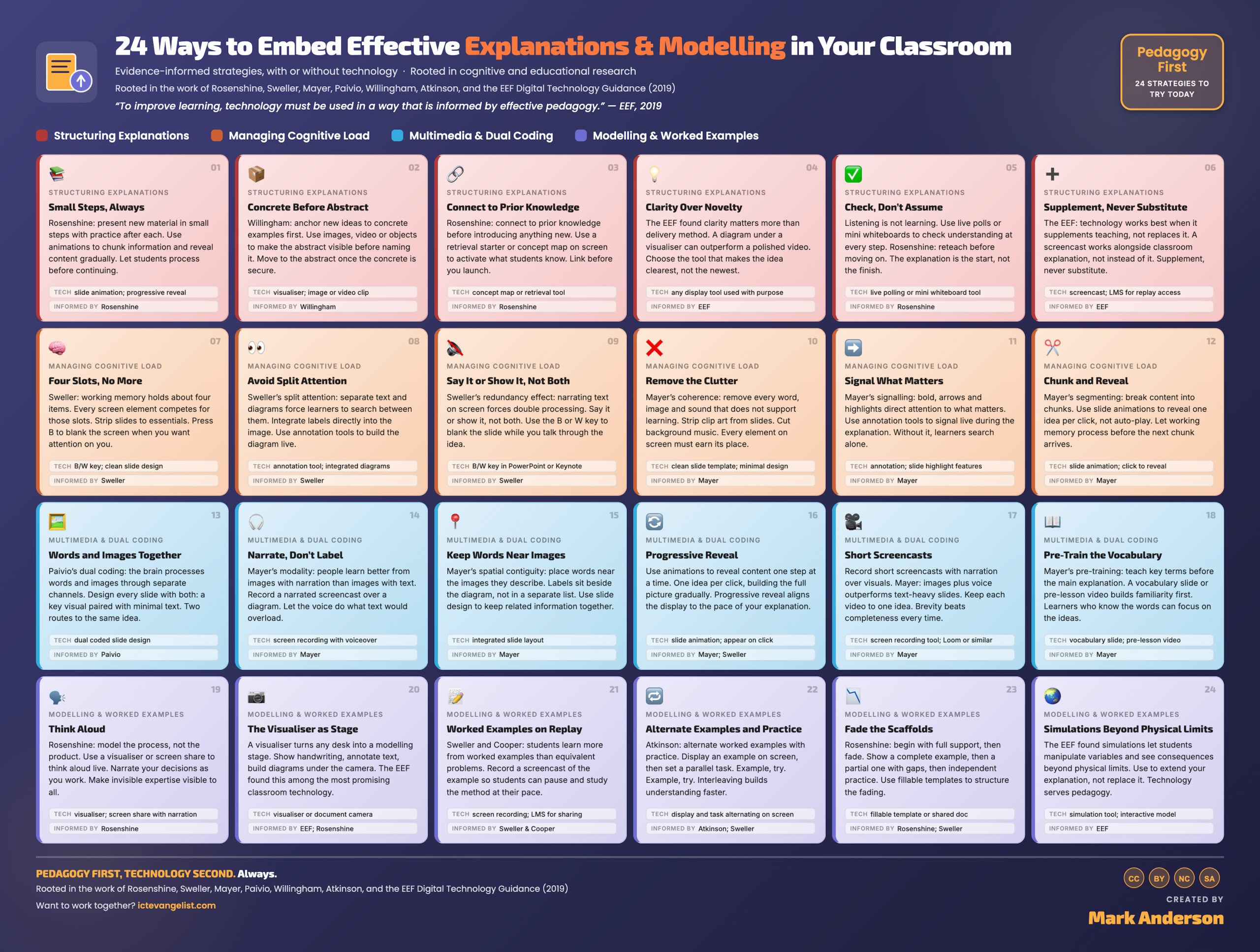
As always, it’s free to download, print and share (with a Creative Commons licence). I’d love to hear how you’re using it if you do!
You’ll find all 24 strategies, each with its own page, and the infographic to download on the Pedagogy First site: Explanations and Modelling on Pedagogy First.