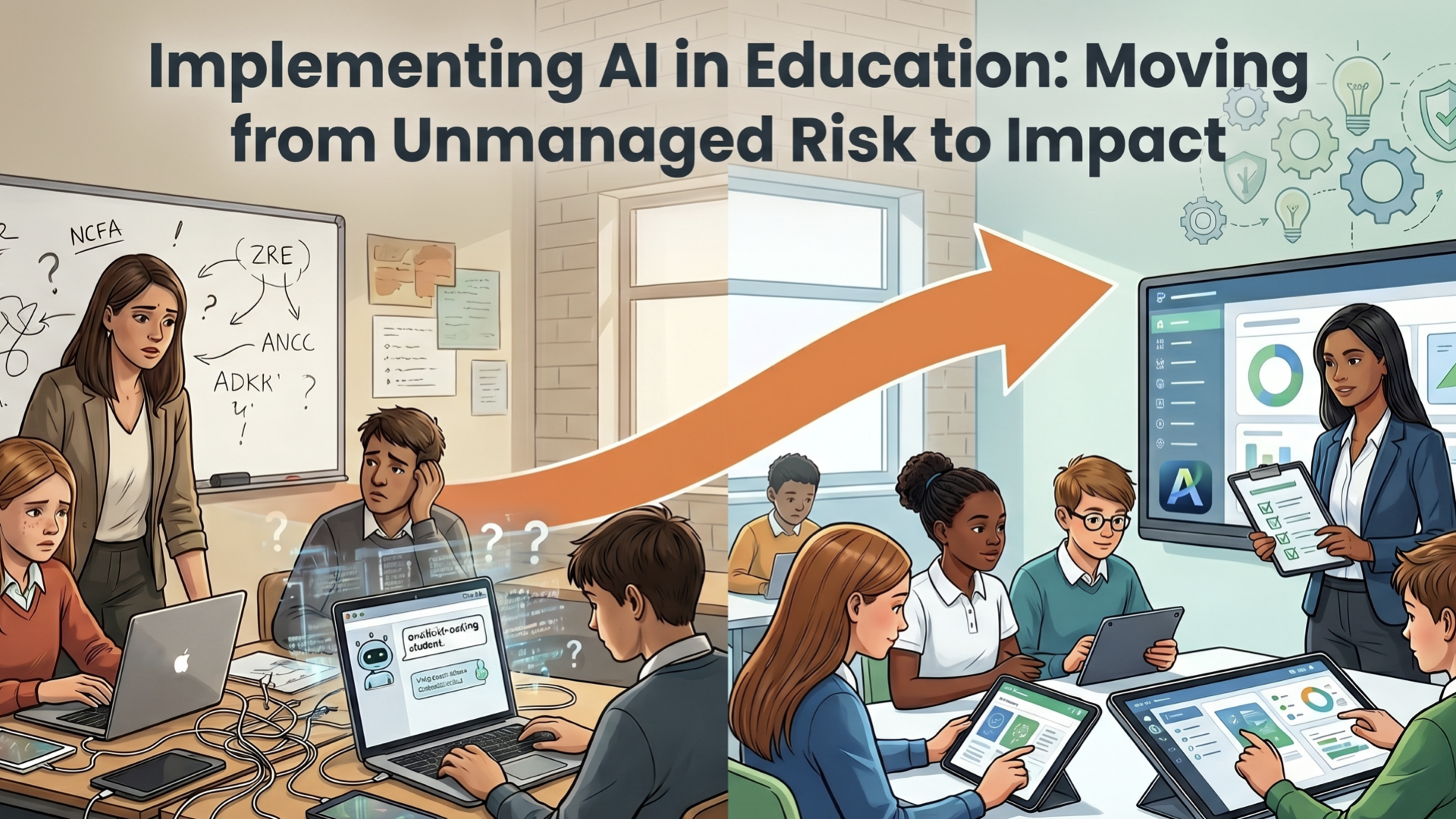
If someone asked you, right now, what AI is doing for education, what would you say? I’d put money on at least one of these: saving teacher time, reducing workload, improving outcomes. These things get repeated so often wherever I look, it’s like they have become the manuscript for every conversation around EdTech. It’s laudable, but the problem is that many schools I visit or hear about are still some distance from that. Some, for sure, are doing brilliantly, and I’ll come onto those later, but for what I would say is the most part, this isn’t the case.
For sure, the conversation has genuinely shifted in the last twelve months. I like to think that the new 2026 Digital Strategy Guide that I co-authored with Al Kingsley and Liz Bury is really helpful. I also see that more school leaders are asking better questions before buying.
But here’s what I’m still seeing in schools. Teachers (and leaders too) are reaching for the nearest consumer tool, often ChatGPT, for everything and sometimes for tasks that involve sensitive pupil information. No DPIA. No consideration of data residency. No thought given to whether the tool meets the DfE’s product safety expectations. Just a busy professional trying to get something done faster.
I understand that. Genuinely. But when every member of staff is making their own choices about which AI tools to use, with no shared framework and no oversight, you don’t have a digital strategy, let alone an AI strategy. It’s spaghetti. All tangled up. Uncoordinated. Unmanaged. And in some cases, carrying real risk to pupil data and safeguarding.
The DfE Product Safety Expectations: Are You Using Them?
Back in January, just ahead of Bett, the DfE released their product safety expectations for AI in education, and I remember thinking: finally, someone in government gets it.
Thirteen areas. Filtering built into the product itself, not applied retrospectively. DPIA-ready documentation from suppliers. Cognitive development safeguards. Monitoring and reporting requirements. Governance. Mental health protections. Each one naming something that actually matters. It’s solid.
I quickly produced my own guide to translate those expectations into something practical and checkable, something you can use in a procurement conversation or take to your SLT for conversation. If you’re evaluating any AI tool for use with children and young people, I’d humbly suggest that you should really consider giving it a read before you do so. Ignorance is no longer an excuse when the safety expectations are laid out this clearly.
What Do Schools That Have Moved from Hype to Impact Share?
In my experience, they all have one thing in common, and I’ve been lucky enough to work with schools and trusts that have moved well beyond the hype. The pattern is consistent. Every time.
They start with people, not products.
Woodland Academy Trust is a good example. Their approach to AI in education is documented in a report I co-authored with Julie Carson, available at bit.ly/woodlandaireport. What strikes me about Woodland is that their success is as much about the people involved as it is about any tool. They’ve built a lean, considered ecosystem. They haven’t tried to do everything at once. They’ve asked what problems they’re actually trying to solve before reaching for a solution. Every new tool, for example, that is brought in, training is obviously part of it, but a whole term has to pass before they consider bringing anything else new to the table. The technology serves the people. Not the other way around.
That’s the difference between a digital strategy and using a plaster as a short-term solution. Each tool considered is in response to a specific problem they are facing, and implementation is done slowly, well and with support.
The One Thing I Most Want School Leaders to Stop Believing About AI in Education
People keep saying that AI can save time and help with learning. I hear it everywhere, even I say it. And it is true. But the important thing to remember is, AI can’t save time or improve learning on its own. It’s all about people and what happens between the device and the chair.
Teachers who know how to teach and who also understand how to use AI well can save themselves time. They can support and extend learning. That combination, real pedagogical expertise applied with judgment to the right tools, is where impact lives. Take away the pedagogical expertise, and you have outputs nobody is equipped to evaluate, question, or adapt.
This isn’t a criticism of AI. It’s a statement about how technology has always worked in education. I’ve been saying it since the iPad 1:1 implementation I worked on with colleagues at Clevedon School in 2010. I’ve been saying it ever since.
The technology doesn’t determine the outcome. The teacher does.
So why do we keep pretending AI in education is different? It isn’t.
Pedagogy first. Technology second. Always.
The hype will keep coming. New tools will arrive with new promises. The question worth asking every time shouldn’t be “what functionality does this tool have?” It should be, “what problem are we seeking to solve where technology might help?” or “are our teachers equipped to make best use of this tool?” or “does this tool work well with our existing ecosystem?”.
Focus on answering key questions because the truth is, adding technology when problems already exist can not only often amplify those problems, but it can create new ones too and cost you a lot of money while you’re at it.
If you have found this useful, please do share it. If you’re looking to develop your strategy, need some support or simply a training or Inset day session, book in a call to see how I can help. You can schedule a time to speak with me directly at ictevangelist.com/contact.