Inspection preparation is a familiar pressure for school and trust leaders. The expectations of the new Ofsted framework require clarity, alignment and well-structured evidence, yet you rarely have the time you need to bring everything together in a coherent way.
What should be a professional conversation often becomes a last-minute scramble to gather documents, cross-check information and second-guess what might be asked on the day. Today’s Appvent reveal focuses on a tool designed to reduce that pressure and give you greater confidence in the story you tell.

Intelligent Evidence: Insights to support your narrative
Today’s focus is on a tool to help school and MAT leaders called Intelligent Evidence, an AI-powered tool that takes your evidence, as you gather it, to pull it together, ready for when any ‘visitors’ might come.
AI Tool of the Day: Intelligent Evidence
Intelligent Evidence supports you to build a clear, inspection-ready evidence base using documents you already have. You simply upload existing materials, such as SEFs, improvement plans, policies or reports, and the platform maps them to the relevant descriptors across both the current and the new 2025 frameworks.
It highlights where evidence is strong, where alignment is less clear and where the narrative might benefit from further refinement. You remain firmly in control throughout the process, approving, amending or rejecting each suggested match so the platform strengthens your professional judgement rather than replacing it.
Built by a former headteacher and Ofsted Lead Inspector, the tool reflects the realities of leadership rather than presenting another layer of complexity.
Educational Impact
Although helpful when you are preparing for an inspection, Intelligent Evidence is also a valuable strategic tool. Leaders often describe inspection preparation as unpredictable and time-consuming, yet when evidence is gathered and reviewed gradually, the process becomes a purposeful reflection on the quality of provision rather than a source of stress.
Regular review helps you understand your strengths, identify gaps and maintain a clear view of how your work aligns with the framework. Trust leaders benefit from a consistent approach across schools, supporting fair comparison, shared understanding and more coherent improvement discussions.
Over time, this strengthens transparency, communication and collective ownership of your school’s narrative.
Classroom and School Applications
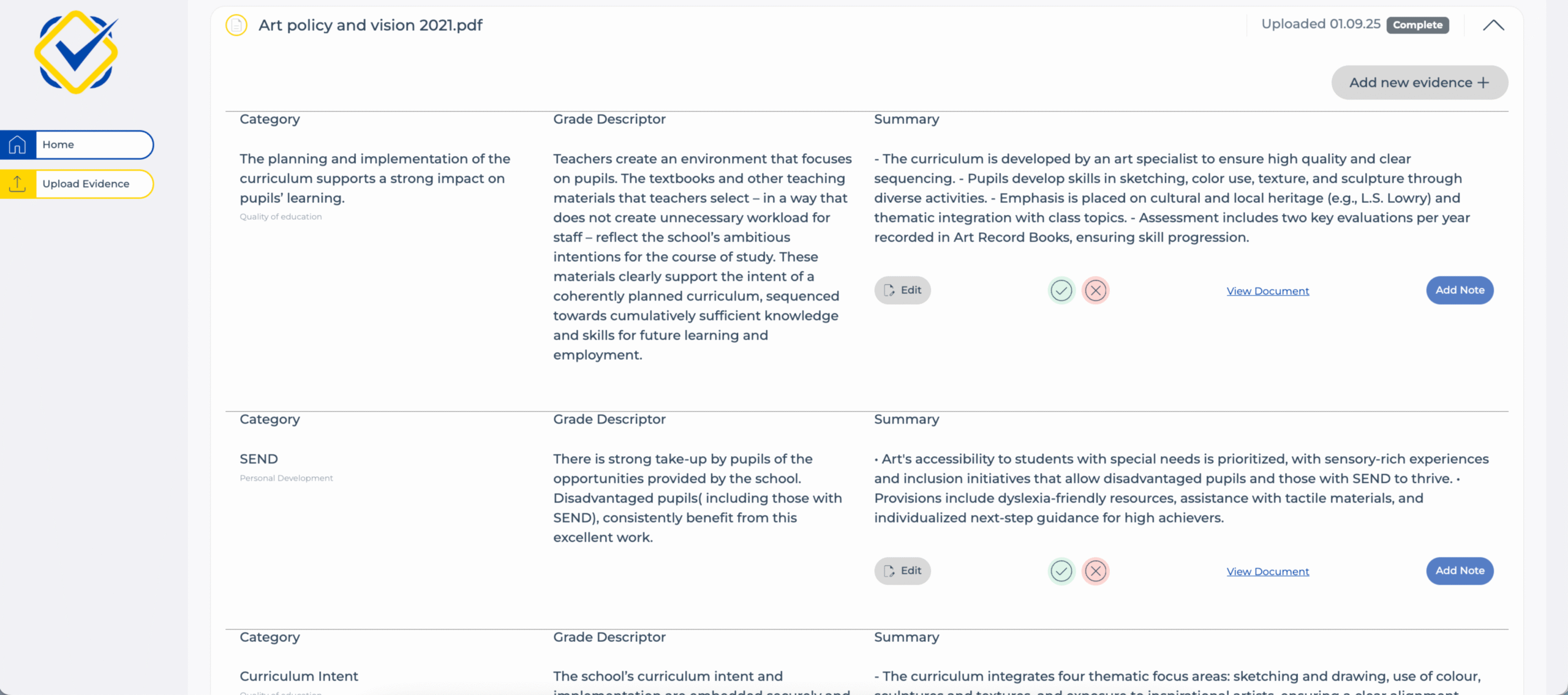
Intelligent Evidence has been designed to fit seamlessly into the workflow of busy school leaders. Once documents are uploaded, the system maps the content to the relevant grade descriptors and presents the analysis in a clear, structured view.
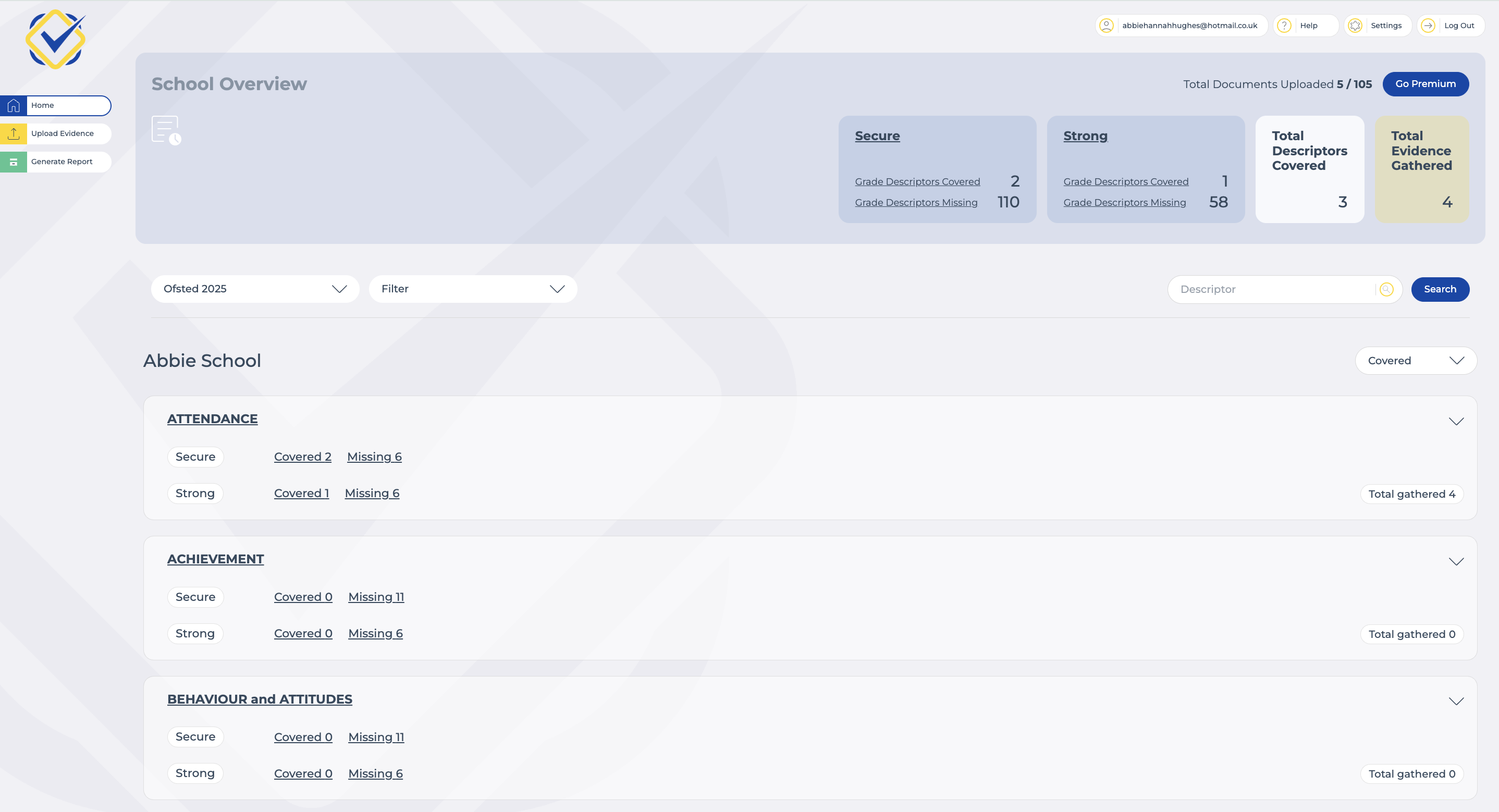
You then review each suggested connection, refine where needed and track progress across the framework. The platform shows what is securely evidenced, what might need attention and where additional clarity would strengthen your narrative.
Because the evidence is continually updated, you are inspection-ready without relying on last-minute preparation. Reports can be exported when needed, giving you a coherent set of materials for internal review or external scrutiny.
Considerations for Implementation
Thoughtful implementation ensures you get the most from the platform. Starting with a small set of core documents allows you to see how the system works before expanding your evidence base.
The option to work with either the 2019 or 2025 framework supports schools navigating the transition between the two. Your professional judgement remains central throughout. The platform does not evaluate for you; it highlights connections and patterns so you can make informed decisions about what the evidence shows.
Data privacy is handled with care. Documents remain private to your school unless you choose to share them, and the system does not use uploaded materials to train external models.
For many leaders, this reassurance is an essential part of adopting any new digital tool.
Final Thoughts
Intelligent Evidence gives you a clearer, more sustainable way to prepare for inspection and understand the strength of your documentation throughout the year. I have to say, when Steve Kirkpatrick, the founder, got in touch and asked me if I’d like a demo, I wasn’t quite sure what to expect, but it’s super easy to use and helps put everything in one, easy to use, easy to find, transparent and helpful place.
By reducing the time spent on manual cross-referencing and supporting regular, low-stakes reflection, it creates space for you to focus on what matters most: improving outcomes for children and young people.
It is a thoughtful example of how AI can support leadership without undermining the professionalism and expertise that sit at the heart of school improvement.
Learn more about Intelligent Evidence by visiting their website here, or signing up for a free trial where you can upload up to 5 documents here.
Join me tomorrow for Day 3 of the Appvent Calendar, where Emma Darcy shares her chosen tool for strengthening practice across schools.
This is a sponsored review.
This year’s team
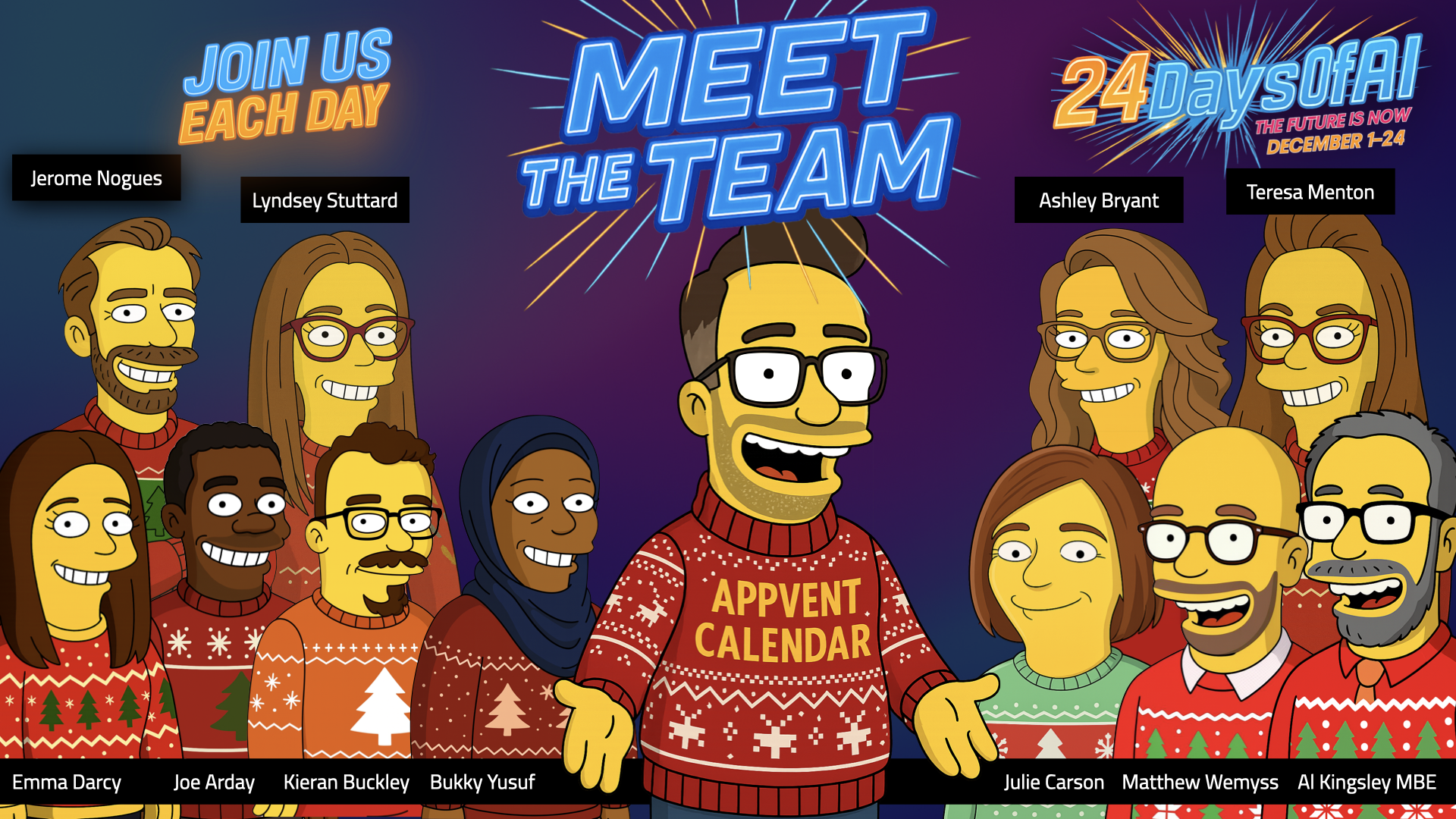
Let me introduce them…
Lyndsey Stuttard – An international educator with 21 years in the classroom, having taught in the USA, UAE, Italy and the UK. She’s an Apple Distinguished Educator with a passion for creativity and the purposeful use of Augmented Reality and a 100 Top Women in Tech for the UK and a Pearson Digital Innovator silver winner.
Teresa Menton – a passionate English teacher with almost 20 years of experience, dedicated to inspiring creativity and critical thinking. A pioneering digital advocate who has driven innovation across schools in the UK and Qatar, leading transformative digital strategies and AI initiatives that redefine teaching, learning, and the future of education.
Al Kingsley MBE – Bestselling Author & Speaker on #Education, #Ai, #EdTech #Growth. CEO NetSupport, Multi Academy Trust Chair, DfE Advisory Board, 24 ISC Global Edrupter, DBT Export Champion, #Edufuturist, BESA EdTech Chair. FRSA (and a lover of dogs and chocolate).
Jérôme Nogues – a teacher, speaker and edtech consultant with 20+ years in education. He champions AI and technology to enhance learning, sharing practical strategies online. Co-author of French learning manuals, CPD coordinator for NCLE and founder of Poésíæ, he empowers educators through creative, meaningful, human-led language learning with global impact.
Ashley Bryant – The Director of IT Innovation (Teaching and Learning) at Frankfurt International School, Ashley is an EdTech enthusiast with a specific passion for making tools accessible for all users. In a previous life, she was a Kindergarten teacher and is now an EdTech leader in a K-12 school.
Bukky Yusuf – A senior leader, leadership coach and author, working with educators on a national and international basis. She has undertaken several leadership roles within mainstream and special school settings. She participates in organisations to increase diverse leadership. Bukky supports the wellbeing of educators and co-edited ‘The Big Book of Whole School Wellbeing’. Beyond the classroom, Bukky is a Trustee and an Ed(ucation) Tech(nology) Thought Leader.
Kieran Buckley – a passionate senior education leader dedicated to advancing AI safety and governance in education and edtech. Advocates for ethical, transparent, and responsible AI adoption in schools. Committed to raising awareness of safeguarding, data protection, and equity issues, ensuring technology supports learning, wellbeing, and trust across educational communities and professional practice.
Julie Carson – the Director of Education for a five-school primary trust in Bexley and Kent, leading education strategy, digital innovation and inclusive practice. She champions Universal Design for Learning and evidence-informed use of AI to enhance teaching, reduce workload, and improve outcomes for all pupils across the Woodland Academy Trust.
Matthew Wemyss – aims to blend educational leadership with AI advocacy, guiding schools to use AI thoughtfully rather than blindly. With hands-on experience in classrooms, he supports teachers, students and leaders to adopt AI in meaningful, ethical ways. His AIGP qualification from IAPP underscores his commitment to governance and responsible AI use in schools.
Joe Arday – is an experienced educator with fifteen years in computer science teaching, working with organisations BCS, CAS, NCCE, STEM Learning UK, Raspberry Pi Foundation, Tech Girls, Tech She Can, Teach First, universities, exam boards, industry partners. He serves on the BCS council, contributes to committees, mentors disadvantaged young people and advises BETT UK and Kingston University. Joe sits on the DfE Edtech Evidence Advisory group on AI in education. He was Highly Commended as AI Citizen of the Year 2025.
Emma Darcy – the Director of Technology for Learning at Denbigh High School in Luton and an AI and Digital Strategy Consultant. She was recently announced as one of the Bett UK 2026 EdTech 10 List, celebrating ten women internationally who are transforming the education technology landscape.