
Welcome to Day 5 of the 2025 #24DaysOfAI Appvent Calendar!
It is fair to say that today’s tool is one that I have mentioned in almost all of my 85 keynotes, inset days and workshops across 2025 and shared even more widely in conversations on social media and with educators in online places and spaces. I simply love it, and had today’s choice not been taken by the guest author today, I would have included it myself. It features in my Periodic Table of AI Tools In Education To Try Today, and on the last 2 years’ Appvent calendars and other resources too. It is brilliant! But I won’t steal anyone’s thunder.
Today’s Appvent reveal on #24DaysOfAI comes from someone I’ve worked with in many ways over the years. From being my co-presenter who kindly agreed to join me on UKEduStories during the pandemic, a co-presenter on The EdTech Show, and a Global EdTech judge for the last 3 years, this person is long-suffering but massively supportive. She’s a great friend, kind, considerate, and mindful, and that’s just how she is when it comes to what she shares about EdTech. It gives me great pleasure to pass the Appvent Calendar mantle today to the inimitable, Bukky Yusuf.

Introduction
As teachers, we often meet students who find organisation, planning or getting started with tasks far more challenging than the learning itself. For neurodivergent pupils in particular, the executive function demands of school can quickly become overwhelming. Goblin Tools is one of my favourite AI resources because it was created specifically with these learners in mind. Although designed to support neurodivergent students, including those with ADHD, its gentle, structured guidance can help anyone who finds certain tasks intimidating or difficult to initiate.
AI Tool of the Day: Goblin Tools
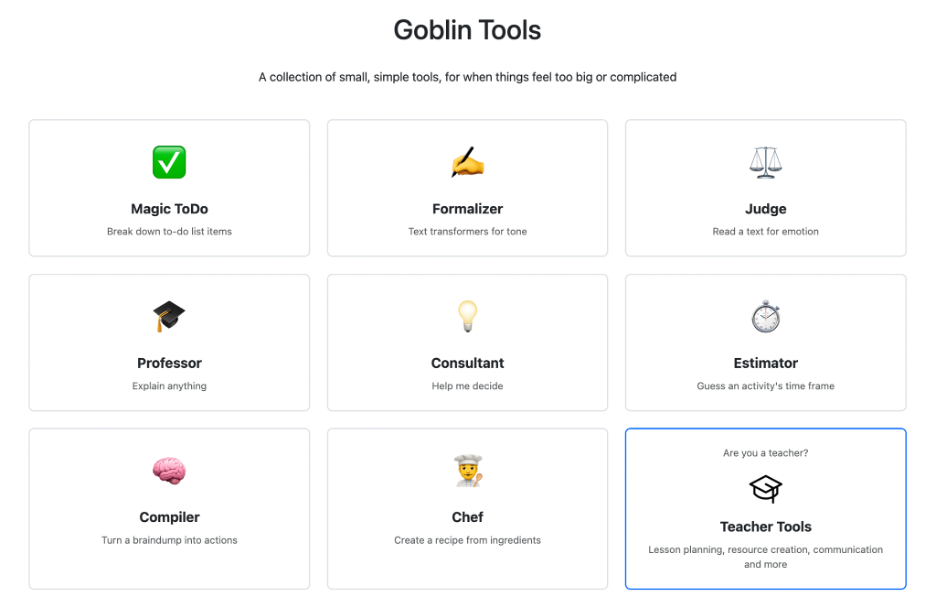
Goblin Tools is a simple but powerful collection of eight single-purpose tools available as a free website. Each tool supports a specific aspect of executive function, organisation or productivity. What I value most is that it never replaces thinking. Instead, it exposes the thinking process, making each step visible so that learners understand how to move from uncertainty to action. For students who experience analysis paralysis, decision fatigue or cognitive overload, this clarity can make a genuine difference to their confidence and engagement.
Educational Impact
The strength of Goblin Tools lies in how it breaks down cognitive demands into manageable, structured processes. The platform helps learners transform scattered ideas into clear plans, estimate how long a task might take, check the tone or emotion within written communication or turn a complex assignment into a series of meaningful steps. For some students, this scaffolding removes the barrier that prevents them from starting. For others, it acts as a model for how to plan and organise their work independently.
Different tools offer different kinds of support.
- Chef helps students generate recipes from ingredients, which can extend into practical curriculum contexts.
- Compiler turns fragmented thinking into coherent actions.
- Consultant supports decision-making by presenting pros and cons before offering a suggestion.
- Estimator gives pupils a sense of how long a task might require, a skill many struggle with. Formaliser adjusts tone, which can support GCSE English Language students as they refine letters or formal writing for specific audiences.
- Judge helps to identify emotion in text, strengthening communication and social understanding.
- Magic ToDo breaks down projects, such as a French assignment, into a clear sequence of steps.
- Professor explains content at different levels of complexity, helping students access unfamiliar material without increasing cognitive load.
Across all of these tools, the chilli icons act as a control for complexity, allowing learners to choose how detailed or nuanced they want the output to be.
Practical Application
In the classroom, Goblin Tools can support subject learning, independent study and pastoral development. Students who are unsure how to begin an extended task can use Magic ToDo to break it down into manageable steps they can follow and tick off. Those preparing written assignments can use Formaliser to refine tone and adjust formality, seeing how language shifts according to audience and purpose. Professor can help students re-engage with prior knowledge or clarify new ideas before they ask for help, empowering them to take more ownership of their learning.
For decision-making tasks, such as choosing between project topics or planning revision strategies, Consultant provides a structured approach that helps students move past indecision. Compiler can be useful for helping pupils organise their thinking after a class discussion or when preparing notes for an assessment. The tools work best when used intentionally and with explanation. They serve as stepping stones towards better independence rather than shortcuts that bypass the learning process.
Considerations and Tips
I always encourage teachers to use Goblin Tools alongside explicit modelling. Helping students understand how and why each tool works ensures they can transfer these habits into their wider learning. The chilli icons offer a helpful way for pupils to choose the level of detail they can manage, so it is worth showing them how to adjust this according to the task. As with any AI tool, the aim is to support thinking, not to hand thinking over.
One of the reasons I trust Goblin Tools is its approach to privacy. The platform does not store input data on its servers, which is reassuring for teachers working within strict safeguarding and data protection expectations.
Conclusion
Goblin Tools provides simple, purposeful scaffolds that help students navigate the executive function demands of learning. By making thinking processes visible and manageable, it supports confidence, independence and meaningful progress. For neurodivergent learners in particular, it can remove barriers that previously felt insurmountable. Yet it remains accessible to anyone who needs help turning intention into action.
My thanks
Join me tomorrow for Day 6 of the Appvent Calendar as we continue exploring tools that support thoughtful, inclusive teaching and learning. I’m delighted to be welcoming Matthew Wemyss tomorrow to share his contribution, and I can’t wait to share it with you.
Please do comment, like, repost and share the Appvent posts, so your PLN can learn too ☺️